
Aayushma Mehta - Author
2026-03-23
Choosing the best IT career in Nepal can feel confusing, especially with so many exciting technology fields emerging today. If you're considering a future in tech, you’ve probably come across three popular options:Full-Stack Development, Data Science, and Cybersecurity along other IT courses. Each of these IT careers offers strong job opportunities, high salaries, and the chance to work in a rapidly growing digital industry.
But how do you decide which path is right for you?
Maybe you're a student exploring IT courses after +2 or after completing your SEE boards, wondering which field has the best job prospects. Perhaps you're a university student interested in building real-world tech skills. Or you might be a professional thinking about switching to a high-demand tech career. Whatever your situation, choosing between Full Stack Development, Data Science, and Cybersecurity can feel overwhelming at first.
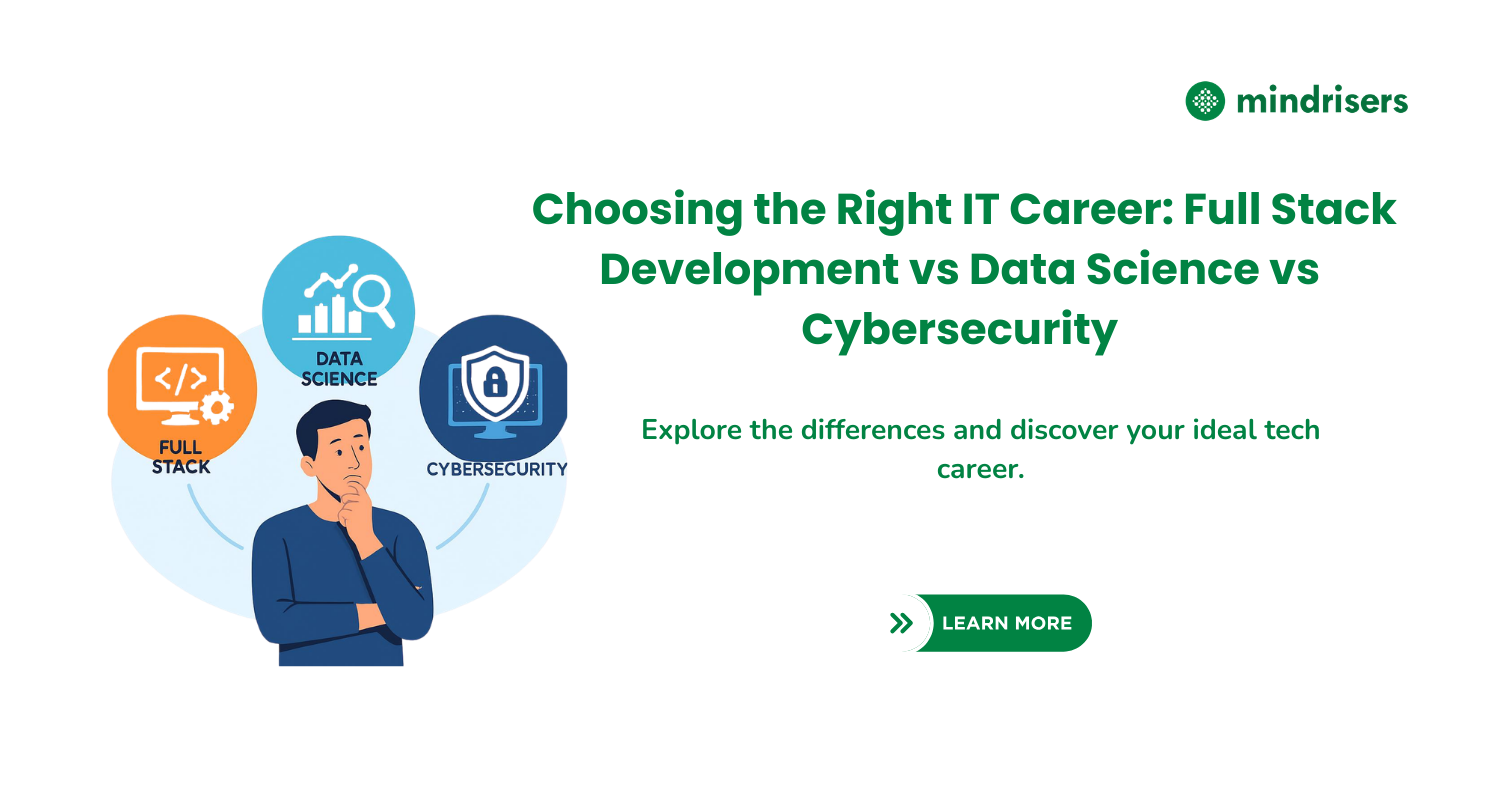
The truth is, each of these careers focuses on a different part of the technology world. Full-Stack Developers build applications and websites, Data Scientists analyze data to generate insights, and Cybersecurity professionals protect systems from digital threats. Understanding these differences is the first step.
This guide will help you understand which IT career in Nepal fits your interests, skills, and long-term goals.
What You’ll Learn in This Blog
In this guide, we’ll explore:
- What Full Stack Developers, Data Scientists, and Cybersecurity professionals actually do
- The skills required for each IT career
- Salary expectations and job demand in Nepal
- Which career suits different personalities and interests
- How to choose the right IT course for your future
By the end of this article, you’ll have a much clearer understanding of whether Full Stack Development, Data Science, or Cybersecurity is the best IT career path for you.
Who They Are
Before choosing between Full-Stack Development, Data Science, and Cybersecurity, it is important to understand who these professionals are and what they actually do in their daily work. Each role focuses on a different part of the technology industry, and understanding their responsibilities can help you decide which IT career suits you best.
Full Stack Developers
Full Stack Developers are professionals who build complete web applications. They work on both the front-end (what users see) and the back-end (how the system works behind the scenes). They are responsible for designing websites, creating server logic, and managing databases.
Full Stack Developers often work in software companies, startups, and web development agencies. They may also work as freelancers or remote developers for international clients. These professionals enjoy coding, building projects, and solving technical problems.
Data Scientists
Data Scientists are professionals who analyze data to find useful insights. They work with large amounts of data and use programming, statistics, and machine learning to understand patterns and trends.
Data Scientists help companies make better decisions by turning raw data into meaningful information. They often work in finance, healthcare, marketing, and business analytics.
Cybersecurity Professionals
Cybersecurity Professionals are responsible for protecting systems, networks, and data from cyber attacks. They work to prevent hacking, detect vulnerabilities, and secure sensitive information.
Cybersecurity experts are needed in banks, companies, government organizations, and IT firms. Their main goal is to keep systems safe from cyber threats.
Full Stack Development: Building Complete Web Solutions
What Does a Full Stack Developer Do?
Full Stack Developers are the jack-of-all-trades in the web development world. They possess the skills to work on both the front-end and back-end of web applications, making them incredibly valuable to employers.
On the front-end, Full Stack Developers create visual elements that users interact with directly. This includes designing responsive layouts, implementing interactive features, and ensuring smooth user experiences across different devices and browsers. They work with technologies like HTML, CSS, JavaScript, and frameworks such as React, Angular, or Vue.js.
On the back-end, Full Stack Developers handle the server-side logic that powers web applications. They work with programming languages like JavaScript (Node.js), Python, Ruby, or PHP to build APIs, manage databases, and handle authentication and security. They also manage server infrastructure, ensuring that applications run smoothly and can scale to meet user demand.
What makes Full Stack Developers particularly valuable is their ability to see the big picture. They understand how every piece of an application fits together, which makes them excellent problem solvers and effective communicators between different teams.
Who Should Choose This Path?
Full Stack Development is perfect for you if:
- You enjoy building visible, tangible products that users can interact with
- You like variety in your work and don't want to do the same thing every day
- You want to understand how entire applications work from start to finish
- You have a mix of creative and logical thinking abilities
- You want to see immediate results from your code
Career Outlook
- Average Salary: NPR 500,000 - 1,500,000 per year (entry to mid-level)
- Demand: High across all industries - every company needs a web presence
- Growth Path: Junior Developer → Senior Developer → Tech Lead → Architect → Engineering Manager
Data Science: Extracting Wisdom from Information
What Does a Data Scientist Do?
Data Science has emerged as one of the most transformative fields in technology. Data Scientists are essentially detectives who uncover hidden patterns and insights within vast amounts of data. Their work helps organizations make smarter decisions, predict future trends, and gain competitive advantages.
The journey of a Data Scientist typically begins with data collection. They gather information from various sources, which could include databases, APIs, web scraping, or even IoT devices. Once they have the data, they spend significant time cleaning and preparing it - this process, often called data wrangling, involves handling missing values, removing duplicates, and transforming data into usable formats.
After preparing the data, Data Scientists apply statistical techniques and machine learning algorithms to identify patterns and build predictive models. For example, they might build a model that predicts customer behavior, recommends products, or detects fraudulent transactions.
But technical analysis is only half the battle. Data Scientists must also communicate their findings effectively to non-technical stakeholders. This requires the ability to tell compelling stories with data, create clear visualizations, and translate complex statistical concepts into actionable business recommendations.
Who Should Choose This Path?
Data Science is ideal if you:
- Love solving complex problems and enjoy mathematical challenges
- Enjoy working with statistics, numbers, and patterns
- Have patience for data cleaning and preparation (this takes significant time)
- Can explain technical ideas to non-technical people
- Want to influence business decisions with your insights
Career Outlook
- Average Salary: NPR 600,000 – 2,000,000 per year (entry to mid-level)
- Demand: Growing rapidly — companies are investing heavily in data analytics
- Growth Path: Junior Data Scientist → Data Scientist → Senior Data Scientist → Lead/Manager → Chief Data Officer
Cybersecurity: Protecting the Digital Frontier
What Does a Cybersecurity Professional Do?
In our increasingly connected world, Cybersecurity professionals serve as the guardians of digital assets. They work tirelessly to protect systems, networks, and data from cyber threats, which are becoming more sophisticated and frequent every day.
The responsibilities of a Cybersecurity professional are diverse and critical. They design and implement security protocols to protect infrastructure from attacks. They conduct vulnerability assessments and penetration testing to identify weaknesses before malicious actors can exploit them. They monitor networks for suspicious activity and respond swiftly when security incidents occur. They also develop security policies and educate employees about best practices.
Cybersecurity requires a unique mindset - the ability to think like an attacker while defending against attacks. Security professionals must anticipate how malicious actors might try to breach systems and develop countermeasures to prevent those attacks.
The field demands continuous learning because cyber threats evolve rapidly. What was secure yesterday might be vulnerable today due to new attack techniques or discovered vulnerabilities.
Who Should Choose This Path?
Cybersecurity suits you if you:
- Enjoy problem-solving under pressure
- Want to protect people and organizations from digital threats
- Can keep learning continuously (threats evolve fast)
- Have strong ethical standards and integrity
- Thrive in high-stakes situations
Career Outlook
- Average Salary: NPR 500,000 – 1,800,000 per year (entry to mid-level)
- Demand: Very high -there's a massive talent shortage globally
- Growth Path: Security Analyst → Security Engineer → Security Architect → CISO (Chief Information Security Officer)
Quick Comparison
|
Factor |
Full Stack |
Data Science |
Cyber Security |
|
Best for |
Building applications |
Analyzing data |
Protecting systems |
|
Main Skills |
Programming, Frameworks |
Statistics, ML, Python |
Networking, Security Tools |
|
Learning |
Moderate |
Moderate to Steep |
Moderate to Steep |
|
Job Variety |
Very High |
High |
High |
|
Industry Scope |
Every Industry |
Every Industry |
Every Industry |
|
Starting Salary |
NPR 500K-800K |
NPR 600K-1M |
NPR 500K-900K |
Which Career Matches Your Personality?
Think about what makes you tick. Your personality matters more than you think when choosing a career. Ask yourself these simple questions:
Choose Full Stack If...
- You want to see your code come to life as a working product
- You enjoy switching between design and logic
- You like having a complete picture of how things work
- You want to be involved in a project from start to finish
Choose Data Science If...
- You're naturally curious about patterns and relationships
- You don't mind spending time cleaning messy data
- You want to influence business decisions with insights
- You enjoy working with numbers and statistics
Choose Cybersecurity If...
- You thrive in high-pressure situations
- You want a career with real impact and purpose
- You love continuous learning and staying updated
- You have a strong sense of responsibility
Skills You Need to Succeed
Full Stack Developer Skills
As a Full Stack Developer, you'll need to master both front-end and back-end technologies:
- HTML, CSS, JavaScript - Foundation of web development
- Front-end frameworks - React, Angular, or Vue.js
- Back-end languages - Node.js, Python, or Ruby
- Database management - MySQL, PostgreSQL, MongoDB
- Git and version control
- RESTful APIs
Data Scientist Skills
Data Scientists need a strong foundation in multiple areas:
- Python - Primary programming languages
- Statistics and probability - Theoretical foundation
- Machine learning - Classification, regression, clustering
- Data visualization - Matplotlib, Tableau, Power BI
- SQL and database knowledge
- Communication skills
Cybersecurity Skills
Cybersecurity professionals need comprehensive knowledge:
- Computer networks - TCP/IP, firewalls, VPNs
- Operating systems - Linux, Windows security
- Security tools - Vulnerability scanners, SIEM
- Scripting - Python, Bash, PowerShell
- Problem-solving mindset
- Ethical thinking
Job Market Trends in Nepal
The good news? All three fields are growing fast in Nepal and globally.
Full Stack Development
Every company needs a web presence. From startups to established businesses, demand for web developers remains consistent. The rise of e-commerce, SaaS products, and web-based services ensures that skilled developers will always be needed.
Data Science
Companies in Nepal and worldwide are investing heavily in data analytics. Organizations are recognizing that data-driven decision-making provides a significant competitive advantage. The talent shortage means excellent opportunities for qualified professionals.
Cybersecurity
Cybersecurity faces one of the most significant talent shortages in the tech industry. With cyber-attacks becoming more frequent, organizations are desperately seeking qualified security professionals. This shortage means excellent job security and competitive salaries.
How to Decide: A Simple Framework
If you're still unsure which IT career path to choose, don’t worry - this is completely normal. Many students and professionals struggle to decide between Full-Stack Development, Data Science, and Cybersecurity because all three fields offer excellent opportunities.
A simple way to narrow down your choice is to ask yourself three important questions about your interests, background, and career goals.
1. What Do You Enjoy the Most?
Your interests play a huge role in long-term career satisfaction. Think about the type of problems you naturally enjoy solving.
- Building things → Full Stack Development
If you enjoy creating websites, apps, and digital products from scratch, Full Stack Development could be the right path. Developers get the satisfaction of turning ideas into real applications that people can use.
- Finding insights → Data Science
If you enjoy analyzing information, spotting patterns, and answering complex questions using data, Data Science may suit you best. Data Scientists help companies make smarter decisions using data-driven insights.
- Solving threats → Cybersecurity
If you're fascinated by how systems can be attacked and protected, Cybersecurity could be a great fit. Security professionals work to identify vulnerabilities, prevent cyberattacks, and protect sensitive information.
2. What’s Your Background?
Your current knowledge and strengths can also guide your decision.
- Programming experience → Full Stack Development
If you already enjoy coding or have experience with programming languages like JavaScript, Python, or Java, Full Stack Development may be easier to start with.
- Math or statistics background → Data Science
If you're comfortable with numbers, statistics, and logical analysis, Data Science might feel more natural because it involves data analysis, machine learning, and statistical thinking.
- IT or networking knowledge → Cybersecurity
If you’re interested in computer networks, operating systems, and how systems communicate, Cybersecurity could be a strong match.
The Role of Quality Training
No matter which path you choose, quality training matters. Self-learning can only take you so far. A structured program gives you:
- Hands-on projects for your portfolio
- Mentorship from industry experts
- Career guidance and job support
- Credible certifications
- Networking opportunities
At Mindrisers Institute of Technology, students receive comprehensive training in all three fields. The focus is on practical skills that employers actually want. Whether you want to build applications, analyze data, or secure systems, quality education can fast-track your career and give you a competitive edge in the job market.
Final Thoughts
There's no single "best" career. The right choice depends on you - your interests, skills, and goals.
- Full Stack Development is perfect if you love building complete products and want variety in your work.
- Data Science is ideal if you're curious and love turning numbers into actionable insights.
- Cybersecurity is great if you want to protect others and enjoy continuous challenges.
If you are still unsure which path suits you best, one practical approach is to experience each field before making a decision. You can take free demo classes for Full Stack Development, Data Science, and Cybersecurity to understand how each course works and which one matches your interests and learning style the most.
Take your time. Try free courses in each field. Talk to professionals working in each area. See what clicks.
The tech industry needs skilled people in all three areas. Whatever you choose, you're stepping into a world of opportunity. Your future in tech starts with one decision. Make it count with Mindrisers.
Recent Post
View All
Artificial Intelligence is Taking over CyberSecurity
2026-08-04.331 Views
Mindrisers’ Updated Cybersecurity Course: AI-Integrated Training for the Future
2026-07-31.366 Views
How to Engage Your Target Audience as a Creator in Nepal: Real Tactics That Actually Work in 2026
2026-06-24.564 Views
Which Platform Should Nepali Creators Start On in 2026?
2026-06-12.921 Views

Never miss an Opportunity !
Want to learn TOP 2025 IT Skills ?
We open IT skill classes Monthly in Design, Development, Deployment, Data etc.
Have something to Ask ?
get admission enquiry